Chapter 1. Introduction
Talk about what’s non-convex optimization. Why study it? Most of practical problems can be modeled as non-convex optimization.
Two examples: the sparse recovery(find the independent fators or when given data item n « facotrs p), the recommond system (low rank matrix compeletion)
THe non-convex optimization can be solved by convex relaxation approch (for example LASSO formulation). note: structured problem lead to absent relaxation gap
Chapter 2. Mathematical tools
convex analysis
-
convex combination
-
convex set
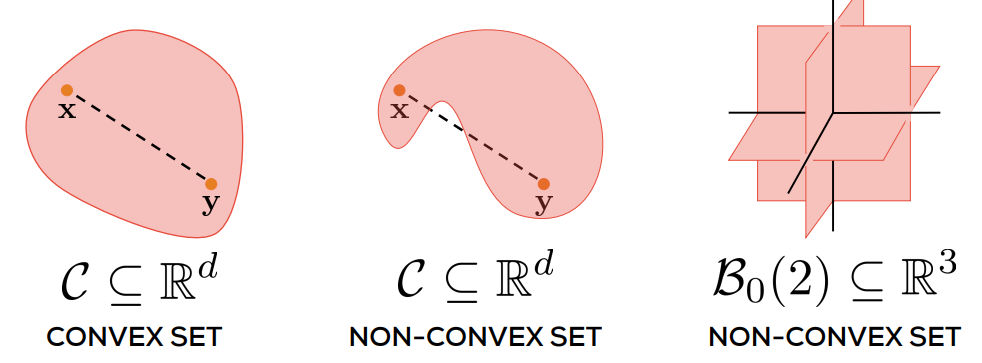
-
convex function (must be continugous differentiable?) might not be continugous and differentiable
https://www.zhihu.com/question/31437665
closed set has the min/max point. open set might not
a. strongly convex / strongly smooth (ss function is not must to be convex?) must to be convex. but might not derivated
strongly convex must be strictly convex
vise via not (https://math.stackexchange.com/questions/2194323/what-is-a-strictly-convex-function-that-is-not-strongly-convex)
| y = | x | + x^2 is strongly convex, but not derivated at point zero |

b. Liptichitz function / Jensen inequality


convex project (are PPI/II/O require the project function to be norm-2?)
- first order properties: PPI/ PPII

if z not in C, then the angle is not acute angle

- zeroth order property: PPO

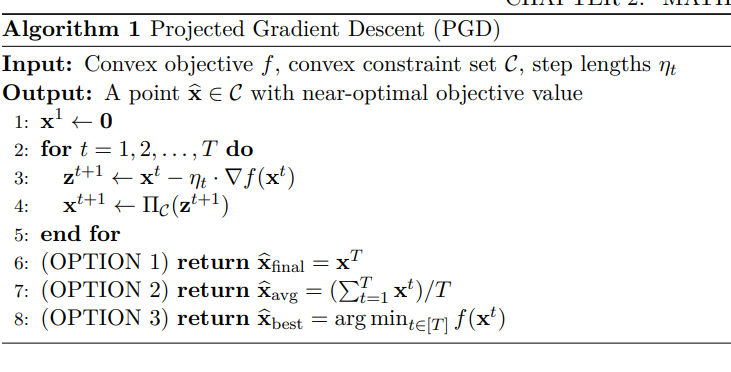
projected gradient descent